A large-area security project is rarely won or lost on optical zoom alone. A PTZ camera may look suitable on a datasheet yet create project risk if the supplier cannot support the required sensor combination, control workflow, integration documents, acceptance testing, or product lifecycle.
For that reason, a credible PTZ camera brand ecosystem comparison should evaluate what surrounds the equipment, not publish another subjective brand ranking. The objective is to determine whether a supplier can support the complete path from site requirements to commissioning and long-term operation.
This guide gives system integrators, project contractors, OEM/ODM buyers, and procurement teams a repeatable method. It uses a weighted scorecard, defines the evidence suppliers should provide, and shows how evaluation priorities change across border, coastal, critical infrastructure, and anti-drone projects.
What a PTZ Camera Brand Ecosystem Includes
A brand ecosystem is more than a catalog of cameras. It includes the available PTZ and pan-tilt platforms, compatible imaging payloads, integration resources, engineering response, quality documentation, maintenance process, and lifecycle support that surround each product.
This distinction matters because large sites normally involve several linked decisions. The observation task determines the sensor payload. The payload affects the pan-tilt platform, mounting, network design, and control workflow. The control workflow affects VMS, command-center, alarm, or third-party sensor integration. Installation conditions then affect environmental requirements, maintenance access, and acceptance tests.
A single impressive specification cannot prove that this chain will work. Brand recognition cannot prove it either. Procurement teams should therefore compare suppliers against the same project-defined evidence rather than award points for familiar names.
Before scoring any supplier, write a one-page operational definition covering the site, target types, observation zones, lighting, weather exposure, mounting positions, operator workflow, network constraints, required integrations, and acceptance criteria. Without this baseline, a brand comparison becomes a comparison of marketing materials rather than project fit.

Build a Weighted Brand Ecosystem Scorecard
Use a 100-point scorecard and set the weights before quotations arrive. This prevents the team from changing its priorities after seeing a preferred product or price. The model below is a starting point, not an industry standard; adjust it to the project’s actual risk.
| Evaluation dimension | Weight | Configuration-specific evidence to request |
|---|---|---|
| Portfolio and payload fit | 20 | A rationale linking the site task to visible, thermal, EO/IR, laser rangefinder, multispectral, or separate pan-tilt options. |
| System integration readiness | 20 | Protocol, stream and control documents; VMS test scope; API or SDK resources when required; alarm and user-access workflows; and a named integration contact. Use the detailed ONVIF and VMS integration checklist. |
| Project engineering response | 15 | A response to the site packet that identifies missing inputs, configuration tradeoffs, customization, and claims requiring tests. |
| Evidence and documentation quality | 15 | A matching datasheet, interface information, installation guidance, drawings where needed, test material, and document dates or revisions. |
| Reliability and maintainability | 15 | Environment and duty-cycle review, mounting and cable details, service access, diagnostics, replaceable assemblies, and confirmed support terms. |
| Lifecycle and supply continuity | 10 | Product status, expected availability, update and change-notification process, spare-part approach, and discontinuation handling. |
| OEM/ODM and commercial fit | 5 | Requirements review, sample approval, change control, branding and documentation process, lead time, minimum order quantity, and ownership of custom work. Keep unconfirmed fields as Data Not Available. |
Score each dimension from 0 to 5, then apply its weight. A zero means no relevant evidence was supplied; a five means the response is complete, configuration-specific, and suitable for review. Keep comments beside every score so a technical reviewer can reproduce the decision.
Some requirements should be pass/fail gates rather than weighted preferences. For example, a mandatory control interface, approved cybersecurity document, specified environmental rating, or required compliance record cannot be offset by a strong score in another category. Mark every mandatory item separately and reject non-compliant proposals before commercial ranking.
Require a Supplier Evidence Pack
The scorecard becomes useful only when every supplier answers with comparable evidence. Issue a common evidence-pack request with the RFQ and ask bidders to reference the exact proposed configuration.
The pack should include:
- A configuration schedule listing the product name, sensor or payload combination, accessories, mounting components, power arrangement, and proposed options.
- Product documents that match the quoted configuration, with document dates or revision identifiers where available.
- A requirement-compliance matrix showing “Comply,” “Partially Comply,” “Does Not Comply,” or “Data Not Available,” plus a document reference for each answer.
- Integration evidence covering required video, control, alarm, user-management, network, VMS, API, SDK, or third-party interfaces. Exact support must be verified for the proposed model [TECHNICAL REVIEW REQUIRED].
- Relevant test evidence, such as sample video, motion-control demonstration, interface test record, or a project-specific proof-of-concept plan. The test conditions and configuration should be stated.
- A support and lifecycle statement identifying pre-sales engineering contacts, commissioning support, issue-escalation path, update process, warranty or repair workflow, and product-change notification. Exact service terms require written confirmation [TECHNICAL REVIEW REQUIRED].
Do not accept a hyperlink to a general product page as the entire evidence pack. Public pages are useful for shortlisting, while procurement evidence should identify the exact configuration and the conditions behind each claim. If detection, recognition, identification, tracking, ranging, or environmental performance is material to acceptance, ask how it will be measured in the target scene. JEC’s existing guide to long-range surveillance camera selection provides a deeper treatment of distance and site variables without duplicating them here.
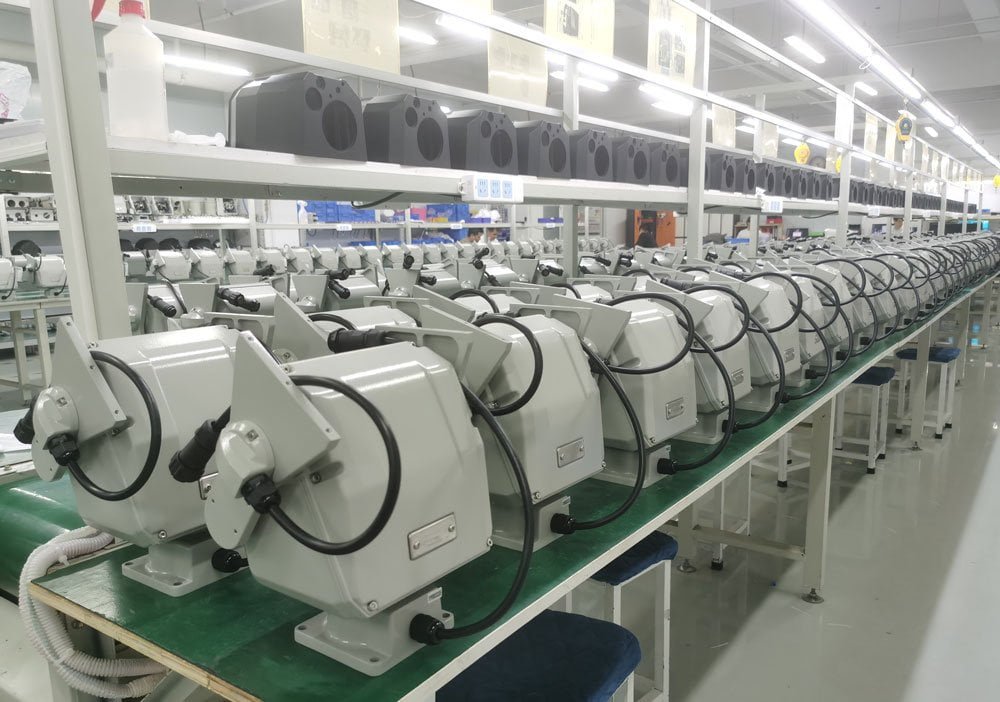
JEC factory video: JEC-PTZ-2315 Series EO/IR Thermal PTZ Camera | Unit Testing Before Delivery.
Project approval should still use configuration-specific test records and acceptance criteria.
Change the Weighting by Project Scenario
The same scorecard can serve different applications, but the weights and pass/fail gates should follow the operating workflow.
Border and coastal surveillance
These projects may combine wide-area observation, long viewing paths, day/night operation, remote mounting, and difficult environmental exposure. Increase the weight for payload fit, environmental evidence, maintainability, and supply continuity. Ask how operators move from initial observation to visual verification and how the proposed configuration handles the site’s actual visibility and mounting conditions. A border surveillance system page can help define the application context, but model suitability and performance still require project review.
Critical infrastructure and industrial perimeters
Integration and operational continuity often deserve the highest weighting. Define who controls the PTZ, what happens after an alarm, how video is recorded, how permissions are managed, and how maintenance teams diagnose faults. Also separate continuous monitoring needs from event-driven tracking. Use the critical infrastructure security overview to frame the site discussion, then place exact interfaces, environmental requirements, and acceptance tests in the RFQ.
Anti-drone and dynamic target projects
Do not score a camera’s tracking claim in isolation. Map the complete chain: detection source, target coordinates or cue, PTZ handoff, operator override, tracking behavior, evidence recording, and recovery after target loss. The supplier should identify which parts are standard, which depend on third-party systems, and which need a proof of concept. Claims about target class, range, accuracy, false alarms, or automated response require technical confirmation [TECHNICAL REVIEW REQUIRED].
Know When to Reject a Brand Ecosystem
A low price should not rescue a proposal with unresolved system risk. Consider removing a supplier from the shortlist when several of these red flags appear:
- The supplier recommends a model without requesting site, target, mounting, environmental, or integration information.
- Distance or tracking claims are precise, but no test conditions, target definition, configuration, or acceptance method is supplied.
- Product names, datasheets, drawings, and quotation descriptions do not match.
- Integration is described only with broad compatibility language, and no responsible technical contact or test plan is offered.
- Mandatory fields are left blank instead of being marked Data Not Available and scheduled for confirmation.
- The supplier cannot explain firmware, product-change, spare-part, repair, or escalation processes relevant to the project.
- Customization is promised before payload, interface, mechanical, schedule, or change-control requirements are reviewed.
One red flag may be correctable. A pattern of vague answers is an ecosystem problem because it makes future engineering, acceptance, and support outcomes difficult to predict.
Where JEC Fits in the Evaluation
JEC’s verified content inventory covers project-relevant categories including PTZ cameras, thermal PTZ cameras, long-range surveillance cameras, EO/IR systems, laser rangefinder cameras, multispectral PTZ cameras, and anti-drone PTZ systems. Buyers can therefore evaluate JEC as a candidate ecosystem across more than one payload or platform type.
For a perimeter or infrastructure shortlist, review JEC’s long-range EO/IR PTZ camera and multi-sensor thermal PTZ camera pages as category entry points. These pages should start the requirements discussion, not replace it.
Apply the same evidence standard to JEC that you apply to every bidder. Ask JEC to map the site packet to a proposed category, identify the exact configuration, provide matching documents, separate confirmed capability from options, and list points that need engineering review. For a formal request, JEC’s thermal PTZ camera RFQ checklist can be used alongside the ecosystem scorecard.
Exact model configuration, interfaces, performance, certifications, environmental ratings, warranty, and service terms remain subject to JEC technical or commercial confirmation. This is not a weakness in the evaluation method; it is the control that keeps a buyer’s comparison traceable.
Practical Next Step
Prepare three documents before requesting quotations: a one-page operational definition, the weighted scorecard with mandatory gates, and the supplier evidence-pack template. Send the same package to each shortlisted supplier and require configuration-specific answers.
Share your site layout, target scenarios, mounting conditions, sensor needs, integration platform, required documents, acceptance approach, and procurement timeline with JEC. JEC can help identify which PTZ camera category or multi-sensor platform should enter the evaluation. Final model selection and technical claims require JEC confirmation.
FAQ
What is a PTZ camera brand ecosystem?
It is the combination of product platforms, sensor payload choices, integration resources, engineering response, documentation, maintenance processes, and lifecycle support available from a supplier. The ecosystem determines whether a camera can move from a promising datasheet to an operable project system.
How should buyers compare PTZ camera brands for large areas?
Define the operating workflow first, then score every supplier against the same weighted criteria and mandatory gates. Require document references and configuration-specific evidence beside each answer. Brand reputation may support initial discovery, but it should not replace technical and procurement evidence.
Which criteria should be pass/fail rather than scored?
Any requirement essential to project acceptance should be a gate. Typical examples include a mandatory interface, approved environmental rating, required compliance document, payload constraint, cybersecurity deliverable, or acceptance-test result. The project team must define the actual gates.
What evidence should support distance or tracking claims?
Ask for the exact product configuration, target definition, scene and weather conditions, mounting assumptions, test method, output evidence, and acceptance threshold. If these are not available, record Data Not Available and require a project-specific validation plan rather than treating the claim as confirmed.
What information should integrators send JEC for evaluation?
Provide the site layout, observation zones, target types, approximate operating distances, day/night conditions, mounting details, environmental exposure, power and network constraints, VMS or control requirements, operator workflow, mandatory documents, acceptance criteria, and procurement schedule.