This shift is visible across the physical security market. In its 2026 global survey of 7,368 security professionals, Genetec reported that AI ranked alongside access control and video surveillance as a leading project priority. The same research found strong interest in integrated systems and flexible on-premises, cloud and hybrid deployment models. It also found that 70% of respondents had concerns about how AI is designed and implemented. The practical message for integrators is clear: customers want useful intelligence, but they also want evidence, control and a supportable architecture.
The following seven trends explain what this means for industrial PTZ cameras, EO/IR systems and standalone pan-tilt units. More importantly, each section identifies questions that should appear in a serious request for quotation.
Edge AI Moves Analytics Closer to the PTZ Camera
Edge AI places at least part of the video analysis workload inside the camera or a nearby embedded processor. For a PTZ project, this can reduce the delay between detecting an object and commanding the camera to follow it. It can also reduce the amount of video that must be transmitted continuously to a central server.
Recent product announcements show how quickly this capability is moving into professional PTZ hardware. For example, Axis announced an AI-powered PTZ camera in January 2026 with edge object analytics, active tracking and support for the AV1 codec. This is an industry example, not a statement about JEC product specifications, but it illustrates a broader procurement change: processing capacity and the analytics environment are becoming camera-selection criteria.
The phrase “AI PTZ camera” is still too broad for an RFQ. Integrators should ask:
- Which object classes can the device detect, classify and track?
- Can analytics continue while the camera is moving or zoomed in?
- What happens when a tracked object is temporarily occluded?
- Does the camera send structured metadata to the VMS, or only a video alarm?
- Are analytics included, licensed separately or dependent on a server?
- How are models, rules and firmware updated?
JEC product naming identifies the JEC-PTZ-2140 Series as an Industrial AI PTZ Camera System and the JEC-PTZ-Dragonfly Series as an AI Auto-Tracking Thermal PTZ Camera. The exact analytics, interoperability and licensing supported by each final configuration require technical confirmation. For a deeper planning framework, review JEC's guide to AI auto-tracking PTZ system design.
Wide-Area Sensors Cue PTZ Cameras Automatically
A PTZ camera can provide detailed views, but it can observe only one direction at a time. This limitation is pushing system design toward a two-layer model: one sensor maintains awareness of a broad area, while the PTZ camera moves to verify and follow an event.
The overview sensor may be a radar, a fixed thermal detector, a panoramic camera or a multidirectional camera. I-PRO announced a radar platform later that year that passes detected location information to AI-enabled PTZ cameras for visual tracking. These examples show the same workflow:
- A wide-area sensor detects or classifies activity.
- The system converts the event into a location or preset.
- The PTZ camera slews to the target area.
- Visible or thermal imaging provides visual confirmation.
- The VMS presents the event to an operator or starts an approved response workflow.
The important specification is not simply “radar integration” or “auto-tracking.” Buyers should verify coordinate mapping, preset accuracy, response latency, VMS ownership of the workflow, multi-target priorities and recovery after the target leaves the field of view.
A high-speed PTZ platform may suit projects that prioritize rapid repositioning. A high-precision or heavier platform may be more appropriate when the payload and long-range optics demand stable low-speed control. The choice depends on the complete detect-to-verify workflow.
Multi-Sensor Payloads Become Project-Specific
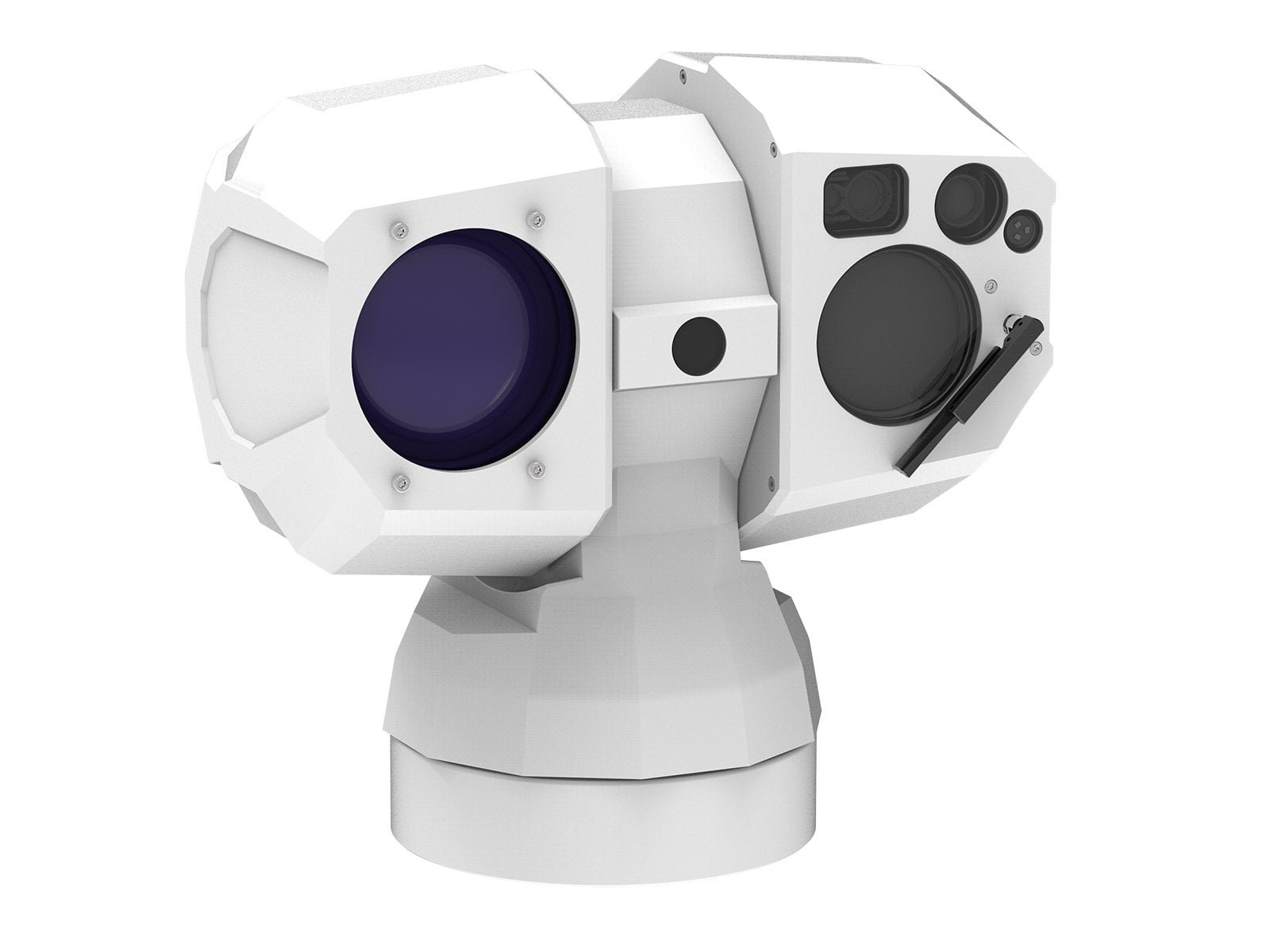
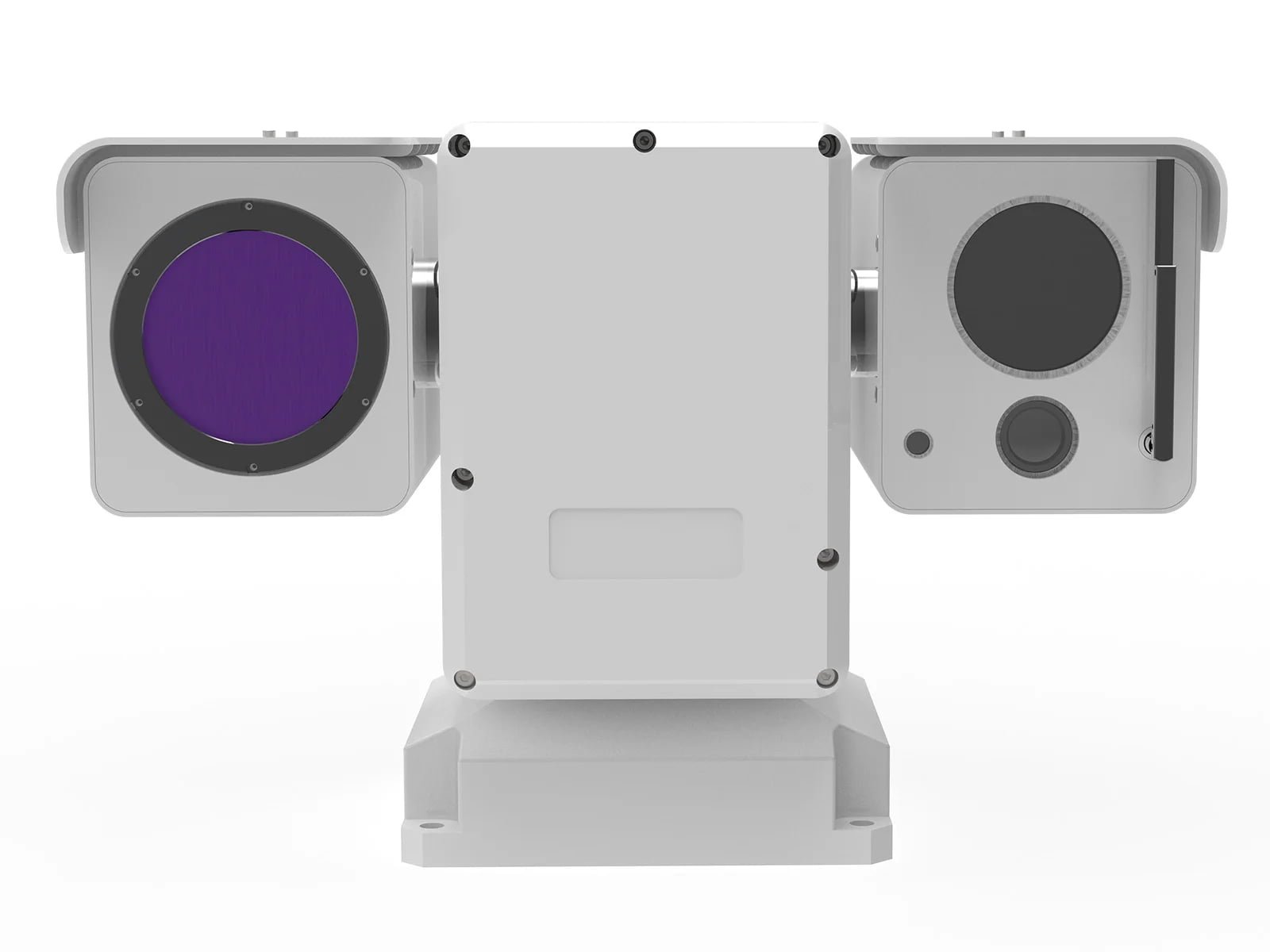
Visible imaging helps an operator interpret color, markings and scene context when lighting is sufficient. Thermal imaging can help reveal heat contrast when visible detail is weak. A laser rangefinder may provide target distance when the operating procedure requires it. Position data can help the VMS or another sensor coordinate a response. Adding every available sensor, however, increases payload, power, integration and maintenance requirements.
For that reason, buyers should begin with the decision the operator must make. Is the task to detect movement, classify an object, verify a target, measure distance or maintain a track? The payload should be designed around that task and the environmental conditions, not around the longest feature list.
JEC's Unmanned & Robotic PTZ cameras cover several integrated product directions. A multi-sensor thermal PTZ camera is relevant when visible, thermal and ranging functions are required in one system. For OEM projects that need a custom enclosure, sensor or optical package, a heavy-duty pan-tilt head may provide a more flexible motion platform than a fixed camera assembly.
Motion Platforms Split Into Application-Specific Classes
PTZ selection is often reduced to maximum speed, but motion performance is a set of tradeoffs. A fast camera is useful only if it can stop accurately, maintain focus, control the selected payload and provide stable video. A heavy-duty unit may carry a larger sensor package, but it may not be the right answer for a small robot or a fast-moving platform.
Four broad product classes are becoming easier to distinguish:
| Motion platform class | Typical project need | Main RFQ questions |
|---|---|---|
| Compact or light-load PTZ | Robots, mobile inspection and space-constrained installations | Total mass, center of gravity, power, vibration and interface |
| High-speed PTZ | Dynamic targets, alarm verification and rapid sensor cueing | Acceleration, stopping behavior, tracking latency and preset repeatability |
| High-precision EO/IR PTZ | Long-range verification and coordinated sensing | Low-speed smoothness, backlash, angular feedback and calibration |
| Heavy-duty pan-tilt system | Large optical housings and multi-sensor payloads | Payload mass and inertia, wind loading, mounting, cable routing and duty cycle |
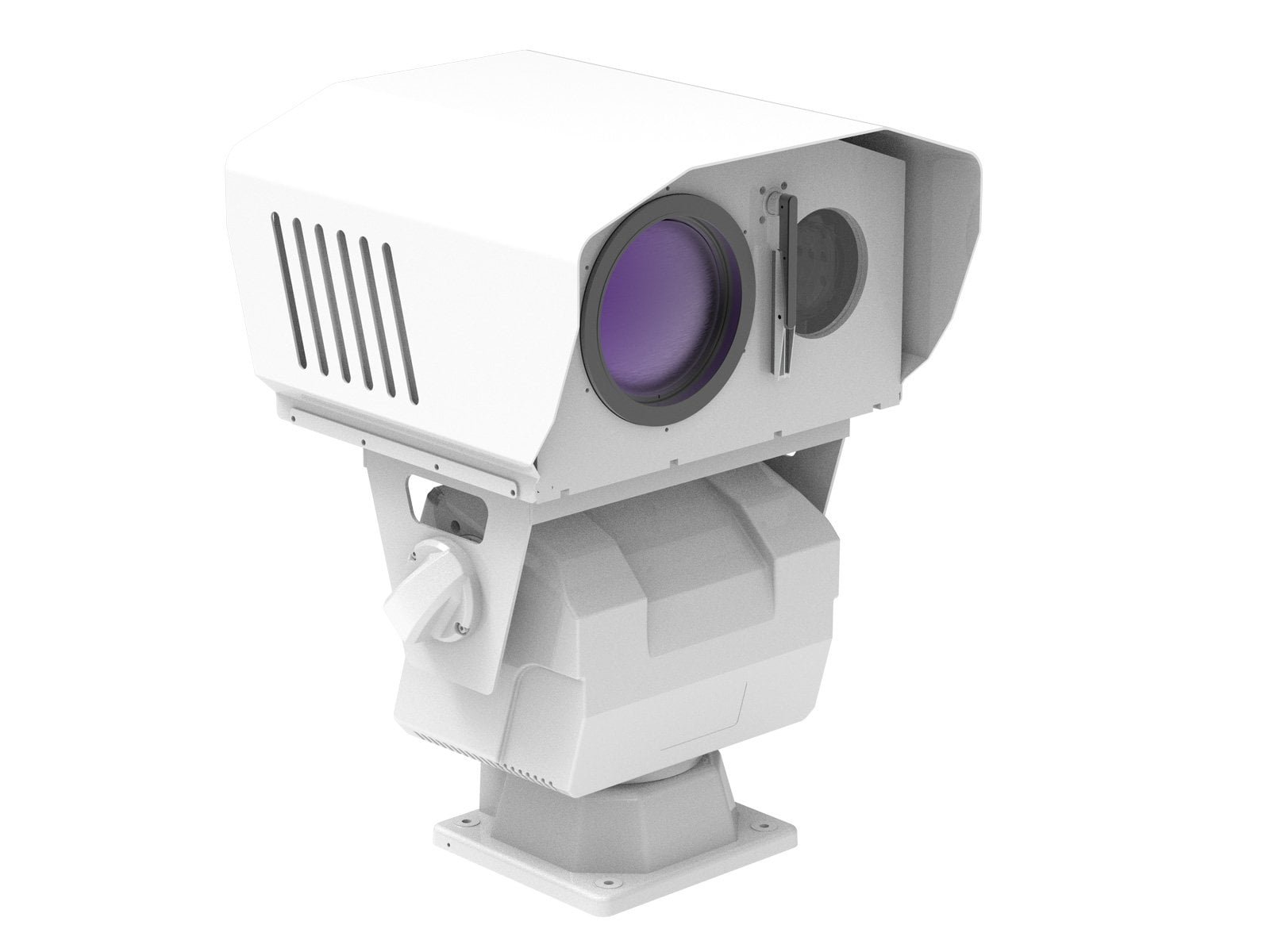
These names identify intended product directions. Final payload, interface, environmental and performance values must be confirmed against the approved specification for the selected configuration.
Metadata Interoperability Matters as Much as Video Streaming
Many buyers use “ONVIF compatible” as a checkbox. In an analytics-led PTZ system, that wording is incomplete because different profiles cover different functions.
ONVIF Profile T addresses advanced video streaming and includes H.264/H.265, imaging settings, metadata streaming and PTZ-related functions. ONVIF Profile M focuses on metadata and events for analytics applications, including object classification, geolocation-related metadata, event interfaces and optional MQTT communication.
This distinction matters. A VMS may be able to display a stream and move a camera while still being unable to receive the analytics metadata needed for search, alarm filtering or automation. Integrators should request the exact ONVIF profile, conformant product record, supported features and VMS test result. They should also test absolute and relative movement, presets, focus, event delivery, timestamps, metadata fields and behavior after reconnecting.
Hybrid Edge, On-Premises and Cloud Architectures Become Normal
The 2026 Genetec research found that organizations want the flexibility to place workloads on premises, in the cloud or in a hybrid model. For PTZ projects, hybrid does not mean that every function should move to the cloud. Fast motion control and time-sensitive tracking may need to remain at the edge or local site, while centralized health monitoring, investigation tools, user management or selected archives may run elsewhere.
A useful architecture starts by assigning each workload:
- Camera or edge processor: immediate detection, classification and tracking where supported.
- Local VMS or controller: PTZ commands, alarm rules, recording and operator workflows.
- Central or cloud service: fleet health, remote access, updates, selected analytics or multi-site investigation where approved.
The RFQ should define what continues working when the wide-area network is unavailable. It should also cover local storage, bandwidth limits, remote access, data residency, user roles, update control and recovery after a connection failure. Cloud readiness should be treated as an architecture decision, not a label on the camera.
Cybersecurity Becomes a Product-Lifecycle Requirement
Every network-connected PTZ camera is also an endpoint with credentials, firmware, services and a maintenance lifecycle. As physical security teams work more closely with IT, cybersecurity questions are moving into camera procurement.
ONVIF's TLS Configuration Add-on addresses standardized configuration of encrypted communication between conformant clients and devices. That is one useful reference, but a complete review should also ask about unique credentials, HTTPS/TLS configuration, disabled services, role-based access, secure boot, signed firmware, vulnerability notifications, audit logs, certificate management, update procedures and end-of-support policy.
The acceptance test should verify the delivered configuration, not only the datasheet. Default passwords should be changed, unused protocols should be disabled, devices should be placed in the approved network zone and the recovery process should be documented. These controls are especially important for remote and unmanned sites.
How to Map These Trends to a JEC PTZ Product Family
The best product family depends on the payload, target behavior, platform and integration workflow. The following starting points use the approved JEC product naming list; they are not a substitute for an engineering review.
| Project requirement | JEC product family to review |
|---|---|
| Robot or compact mobile inspection | JEC-PTZ-720 Series Dual-Sensor Thermal PTZ Camera for Robot Inspection |
| Vehicle-mounted or unmanned platform observation | JEC-PTZ-760 Series Vehicle-Mounted EO/IR PTZ Camera System |
| Industrial monitoring and perimeter security | JEC-PTZ-2140 Series Industrial AI PTZ Camera System |
| Long-range border, coastal or infrastructure observation | JEC-PTZ-2315 Series High-Precision EO/IR Thermal PTZ Camera System |
| Heavy long-range thermal monitoring | JEC-PTZ-7230 Series Heavy-Duty Long-Range Thermal PTZ Camera System |
| Mobile target monitoring and dynamic thermal tracking | JEC-PTZ-Dragonfly Series AI Auto-Tracking Thermal PTZ Camera |
| High-speed EO/IR tracking for anti-drone systems | JEC-PTZ-U Series High-Speed EO/IR PTZ Camera System for Anti-Drone Tracking |
For critical sites, start with the operational concept described in JEC's critical infrastructure surveillance solution, then confirm the camera, motion platform, analytics, VMS and network requirements as one system.
A Practical PTZ Camera RFQ Checklist for 2026
Before comparing quotations, provide each supplier with the same project inputs:
- Site layout, mounting position, target zones and expected target behavior.
- Required visible, thermal, ranging, positioning or auxiliary sensors.
- Payload mass, dimensions, center of gravity and inertia for a standalone pan-tilt unit.
- Required pan/tilt speed, low-speed control, preset accuracy and duty cycle.
- Detection and tracking workflow, including the sensor that first creates the alarm.
- Edge, server and cloud analytics responsibilities and supported object classes.
- VMS version, ONVIF profiles, API/SDK requirements and acceptance tests.
- Network, storage, power, latency and offline-operation requirements.
- Environmental, vibration, corrosion and enclosure requirements.
- Cybersecurity configuration, update process, support period and technical documentation.
A supplier should be able to answer these questions against a defined configuration. When a capability is optional, request the option code and identify whether additional hardware, software or licensing is required.
Frequently Asked Questions
1. What is the most important PTZ camera trend in 2026?
The strongest cross-industry trend is the move from isolated PTZ control to integrated, analytics-led workflows. Edge AI, radar or panoramic cueing, metadata and VMS automation are increasingly evaluated together. The most important feature for a particular project still depends on the operator's required outcome.
2. Is edge AI always better than server-side analytics?
No. Edge AI can reduce latency and bandwidth, while server-side analytics may provide centralized processing, easier model management or support for existing cameras. Many projects benefit from a hybrid design. Buyers should compare accuracy, latency, licensing, update control and failure behavior for the complete architecture.
3. Why combine a panoramic camera or radar with a PTZ camera?
The overview sensor can continue watching a wide area while the PTZ camera zooms in for detail. It can also provide coordinates or an alarm that directs the PTZ to an event outside its current field of view. Integration quality and calibration determine whether this workflow is reliable.
4. What is the difference between a PTZ camera and a pan-tilt unit?
A PTZ camera is a complete imaging system with pan, tilt and zoom functions. A pan-tilt unit is the motorized motion platform used to move a buyer-selected camera, EO/IR payload, enclosure or sensor package. A PTU is often preferred for OEM or highly customized multi-sensor projects.
5. What should “ONVIF support” mean in a PTZ camera RFQ?
The RFQ should name the required profile and functions, such as Profile T for advanced streaming and PTZ-related operation or Profile M for analytics metadata and events. It should also require a conformant-product record where applicable and a test with the target VMS version.
Plan the PTZ System Around the Project Outcome
The 2026 technology landscape offers more options, but a longer feature list does not automatically produce a better surveillance system. Start with the event the system must detect, the evidence the operator needs and the response that follows. Then select the PTZ camera, pan-tilt platform, sensors, analytics and software that can deliver that workflow under the real site conditions.
Discuss your PTZ project with JEC and provide the site, payload, target, integration and environmental requirements. The engineering team can review the appropriate product family and identify which technical capabilities require project-specific confirmation.