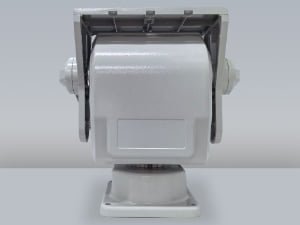
Commercial buyers evaluating a vehicle-mounted PTZ camera are usually past the “what is PTZ” stage. Their real question is whether a mobile surveillance PTZ can stay usable on a moving platform, survive unstable DC input and road shock, hold target detail at night, and integrate cleanly with a VMS or command vehicle platform. JEC’s current public positioning is closely aligned with that problem set: the site emphasizes industrial PTZ systems, thermal PTZ, long-range EO/IR, a vehicle-mounted/night-vision PTZ direction for patrol vehicles and mobile command centers, plus OEM/ODM and global B2B delivery capability.
That framing matters because a patrol camera system is not just a camera on a roof. In the field, it becomes a mobile electro-optical node that must fit the vehicle’s mechanical structure, power architecture, communications stack, and operator workflow. Public-sector references point the same way: FEMA classifies mobile command vehicles as special-purpose on-site platforms for command, control, and communications during emergencies, while DHS and public-safety examples describe mobile command vehicles as tools for restoring coordination, video, internet connectivity, and interoperable communications at incidents and special events.
Where vehicle-mounted PTZ cameras fit
A vehicle-mounted PTZ camera makes sense wherever the incident or observation point moves faster than fixed infrastructure. JEC PTZ now explicitly highlights a “New Night Vision Vehicle-Mounted PTZ” for patrol vehicles, vessels, and mobile command centers, and its compact mobile dual-sensor PTZ product lists vehicle-mounted rapid deployment among its intended applications. JEC’s border surveillance solution likewise presents long-range PTZ, thermal imaging, AI, and networked command architecture as a way to reduce blind zones, improve early warning, and speed response over large corridors.
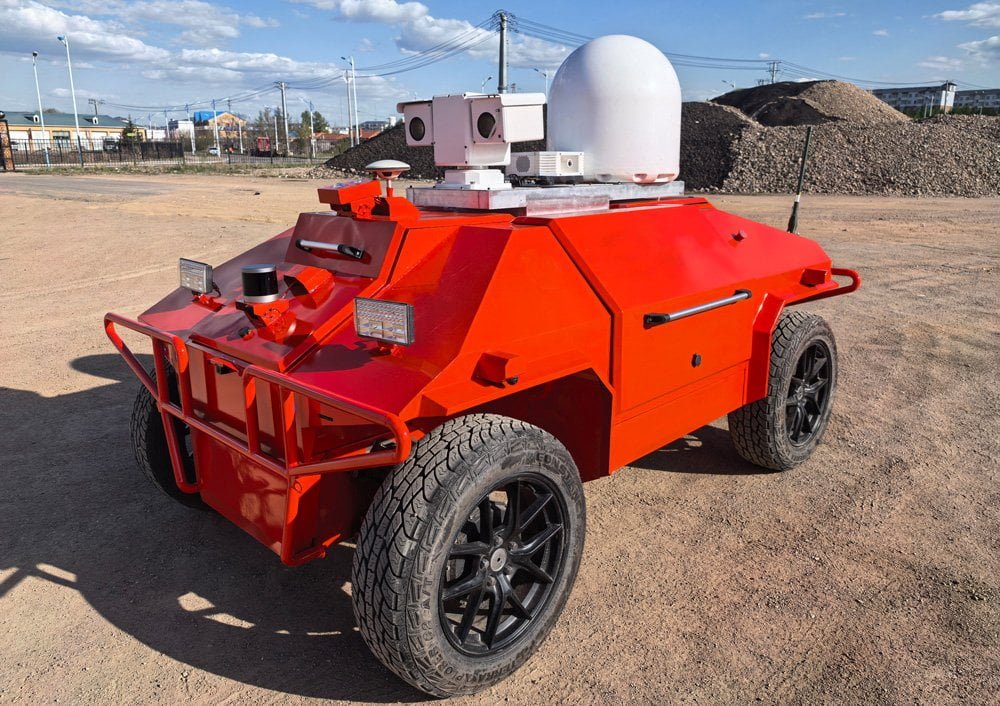
In practical buying terms, that covers several familiar project types. Police or security patrol vehicles use a mobile PTZ surveillance camera to extend visibility beyond the windshield and fixed dash-camera view. Border patrol trucks use it to scan corridors, fence lines, remote approaches, or temporary observation points that may change during a shift. Emergency response vehicles and mobile command centers use it to create an elevated scene overview, feed live video to command staff, and document incident progression when the permanent site infrastructure is absent, damaged, or simply not in the right place.
That same logic extends into fire and EMS operations. San Francisco’s Fire Department policy for mounted cameras on a mobile command vehicle authorizes the technology for incident management at large fire or EMS scenes and describes its operational value as real-time video that helps incident managers allocate resources and identify potential dangers without direct exposure. That is a strong reminder that an emergency response PTZ is not only about security surveillance; it can also be a scene-management sensor for safety, triage, and command decisions.
For border and coastal users, mobility is especially important because the value of the camera comes from placing optics where the threat axis is today, not where a pole was poured last year. JEC’s border solution describes a three-tier architecture with long-range cameras, thermal imaging, radar and AI, while its vehicle- and maritime-relevant product pages point to border patrol vehicles, unmanned ground vehicles, vessels, and maritime monitoring as natural application scenarios. A buyer should therefore classify the project first as fixed-site surveillance with a mobile supplement or mobile surveillance as the primary node, because that decision changes almost every downstream design choice.
Why mobile surveillance PTZ is different from fixed PTZ
A fixed PTZ is usually engineered around permanent height, stable utilities, and long-term sector coverage. A vehicle-mounted PTZ camera adds a different engineering burden: vibration, braking, turning, off-road shock, compact roof real estate, changing or noisy DC input, intermittent network conditions, and the requirement to redeploy quickly. JEC makes this distinction directly in its own guidance, noting that vehicle-mounted systems tend to prioritize compactness, vibration tolerance, and mobile power compatibility, while tower-mounted systems prioritize wind resistance, long range, and stable long-term operation. U.S. Border Patrol’s mobile video surveillance requirements describe a ruggedized surveillance system that must withstand off-road transport, frequent setup and breakdown cycles, transferable installation across different vehicle makes and models, and near-real-time operator control.
| Design issue | Fixed PTZ emphasis | Vehicle-mounted PTZ emphasis |
|---|---|---|
| Mechanical stress | Wind load, long-term holding stability | Vibration, braking, road shock, repeat redeployment |
| Coverage strategy | Tower height and permanent fields of view | Roof or mast height, fast setup, temporary observation angles |
| Power design | Stable site power or predictable DC | Wide DC input, low standby draw, surge tolerance, battery awareness |
| Network design | Persistent LAN or fiber | 4G/5G, satellite, microwave, intermittent backhaul, mobile command links |
| Human factors | Control room operation | In-vehicle interface, seated operator reach, fast entry/exit, field ergonomics |
| Service model | Site maintenance and scheduled visits | Vehicle installation kits, payload swaps, quick transfer between vehicles |
This comparison synthesizes JEC’s mobile-versus-tower guidance with U.S. mobile surveillance requirements for ruggedness, redeployment, and operator usability.
The CBP mobile video surveillance statement of work is especially useful because it describes what “mobile” means operationally rather than cosmetically. It expects near-real-time video and control, defines near-real-time as latency below one second, anticipates extremely rugged terrain, expects systems to be rapidly moved from one deployment location to another, and requires installation kits that let the payload and operator interface be prepared for specific vehicle platforms. In other words, a real patrol camera system is a vehicle system, not a rooftop accessory.
That vehicle-system mindset should also change how buyers think about masts. A telescoping mast or elevated platform can dramatically improve area of coverage without changing the sensor itself. The CBP document states that the mast elevates imaging devices to maximize coverage and overcome terrain obstacles; that same principle applies to emergency response trucks and border patrol vehicles. If the mounting height changes by project or mission, the optical, stabilization, cable-routing, and power assumptions all change with it.
Stabilization and power define field performance
In a mobile deployment, stabilization and power are the two core design filters. If stabilization is weak, a bigger zoom number often makes the user experience worse rather than better, because every vibration becomes more visible as focal length increases. JEC’s compact dual-sensor mobile PTZ explicitly markets stabilized tracking under vibration and states that the gimbal provides 0.05° static stabilization accuracy and no more than 0.3° dynamic stabilization accuracy. JEC’s higher-load outdoor pan-tilt product adds another useful clue: it says the U-type pan tilt actively compensates for vehicle vibration, vessel roll, or wind-induced movement, which is exactly the type of disturbance a stabilized PTZ camera must handle in patrol, coastal, or mobile-command work.
The immediate implication for buyers is that pan/tilt speed should not be evaluated alone. Stability, repeatable pointing, and motion quality under disturbance are usually more important than maximum slew speed on a spec sheet. JEC’s broader industrial PTZ guidance also warns that faster is not automatically better because excessive speed can reduce stability, especially with heavier payloads or exposed installations. For moving vehicles and mast deployments, the better question is not “How fast can it turn?” but “Can it still hold a useful image when the vehicle idles, brakes, turns, or sits on an elevated mast in wind?”
Compact EO/IR mobile-surveillance PTZ shown on JEC’s product page for vehicle-mounted rapid deployment use cases.
Power is the second filter because a mobile PTZ competes for electrical budget with radios, edge compute, displays, in-vehicle recorders, lighting, network gear, and sometimes mast actuation. JEC’s compact mobile dual-sensor PTZ is aimed directly at this constraint set: its page specifies a 10V–36V input range, TVS 8000V anti-surge protection, IP66 weather resistance, standby power at 4W or less, and operating power at 8W or less. That is the profile of a payload that can fit battery-backed or low-power mobile deployments more easily than a traditional heavy outdoor head.
Larger payloads move the design envelope upward quickly. JEC’s long-range multi-sensor thermal PTZ lists DC24V ±20% input and under 24W standby / 40W operating power with payload devices installed. Its visible-first outdoor optical-zoom pan-tilt model lists 24V/48V ±20% as customizable, which is a useful clue for larger command vehicles or specialized platforms with more structured power engineering. What matters for the buyer is not merely that the camera turns on, but whether it will still behave predictably during cranking, transient events, engine-off operation, or surge exposure. That is why wide input range, low standby draw, surge protection, and realistic power budgeting are far more important in a mobile surveillance PTZ than they are in a typical tower camera procurement.
Mechanical size and environmental protection belong in the same conversation as power. JEC’s compact mobile EO/IR model is small enough for constrained integration space at roughly 170 × 320 × 170 mm, while still providing IP66 system protection, an IP67-sealed thermal lens front, and operation from -40 °C to 70 °C. By contrast, the larger multi-sensor platform is a different class of device, with direct-drive motion, larger optics, and a 339 × 333 × 217.9 mm envelope designed for long-range work. Buyers should therefore decide early whether the project needs a lightweight mobile sensor, a roof-mounted command vehicle payload, or a mast-ready long-range surveillance head, because each class drives different expectations for mounting brackets, vehicle reinforcement, damping, cable routing, and maintenance access.
A useful short rule is this: if the project relies on small SUVs, rapid deployment, lower power budgets, or mixed moving-and-stationary use, start with compact stabilized EO/IR options. If the platform is a larger truck, a telescoping mast vehicle, or a border/public-safety vehicle that lives mostly in standoff observation mode, you can justify heavier optics and broader multi-sensor payloads. That is a system trade, not just a camera trade.
Choosing the right sensor stack
The most practical way to choose a vehicle-mounted PTZ camera is to begin with the mission and then select the lightest sensor stack that still answers it. For patrol, border, and emergency response projects, three sensor architectures make the most sense: visible-first long-zoom, EO/IR dual-sensor, and multi-sensor long-range systems. JEC’s current product structure maps well to those three levels.
A visible-first long-zoom package is the right starting point when the primary job is daylight patrol, urban or industrial enforcement, traffic or facility observation, and evidence capture under decent ambient light. JEC’s visible-first outdoor optical-zoom pan-tilt model is a good reference point here: it lists a 1/1.8-inch visible sensor, 10–860 mm focal length, 86x optical zoom, IP66 protection, customizable 24V/48V input, and support for optical target verification at long distance. That class of system is attractive when the buyer needs standoff detail and a strong optical chain, but does not want the added cost, size, and integration burden of a full thermal stack on every vehicle.
An EO/IR dual-sensor package is often the best default for patrol, border, and emergency response because it covers the most operational uncertainty. JEC’s compact mobile dual-sensor model combines a 30x visible zoom camera with a 640 × 512 VOx thermal sensor and a 25 mm thermal lens in a lightweight stabilized housing. The published specs also show why it is attractive for vehicle work: wide 10V–36V power input, very low power draw, all-weather protection, and vibration-oriented stabilization. For projects that must remain useful in darkness, backlight, haze, smoke, or low-contrast terrain, that is a much stronger baseline than visible-only. JEC’s border surveillance case material reinforces the same lesson: the company describes visible-only cameras as struggling in darkness, backlight, haze, and long-range observation, which is why the referenced project adopted a dual-spectrum thermal-plus-visible stack.
A multi-sensor system becomes worthwhile when the project moves from ordinary patrol into longer-range border, airport, port, or high-value public-safety work.
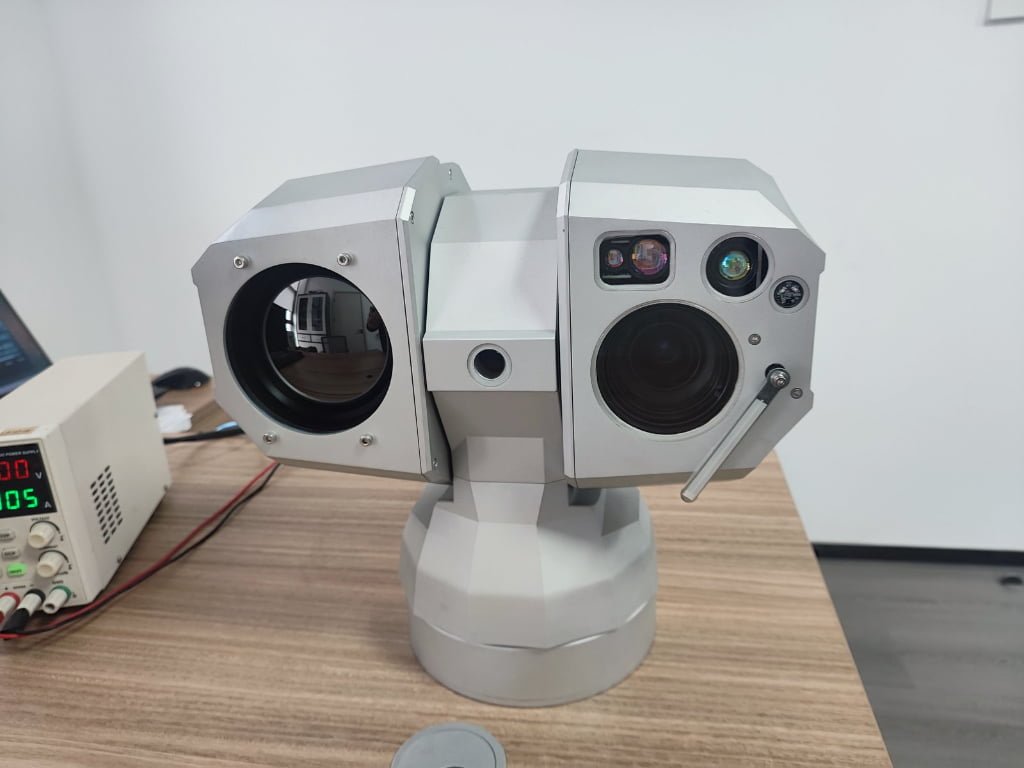
Multi-sensor long-range PTZ platform image from JEC’s product page, used for border, industrial, and critical-infrastructure observation.
The key procurement discipline is to avoid overspecifying sensors just because a page can list them. Every extra payload element adds weight, thermal load, integration work, and operator complexity. If the mission is city patrol or industrial facility patrol with good lighting, a visible-first package may be enough. If the mission is mixed lighting, rural patrol, search support, or border work, EO/IR is usually the most balanced answer. If the mission needs long standoff confirmation, range context, GPS-linked reporting, or integration into larger border/public-safety workflows, a multi-sensor payload can be justified.
Integration requirements for patrol camera systems
For VMS engineers and vehicle-platform integrators, “supports ONVIF” is only the starting point. The more useful question is which ONVIF functions matter for this vehicle-mounted workflow. ONVIF says Profile S is for IP-based video systems and covers video streaming plus PTZ control for conformant devices and clients; Profile G covers recording and control of video data over IP networks or on-device storage, including audio and metadata where supported; Profile T covers HTTPS streaming, PTZ configuration, motion-region configuration, digital inputs and relay outputs, and bidirectional audio where supported; and Profile M covers metadata- and event-trigger-based use cases, including object classification and geolocation-oriented metadata scenarios. For a patrol or command vehicle, that means a complete integration discussion often needs more than one profile.
At the product level, buyers should ask platform questions, not feature questions. JEC’s multi-sensor thermal PTZ page lists ONVIF Profile S/G, RS485/422, PELCO-D, common IP network protocols, Micro SD storage up to 256 GB, NAS storage, alarm I/O, audio I/O, and USB-based expansion. JEC’s compact mobile EO/IR page lists H.265 and H.264 compression support. JEC’s border-solution architecture further describes transmission options that can include 5G, satellite, microwave backhaul, and optical fiber depending on the site. Put together, that means the right integration checklist for a mobile PTZ surveillance camera is broader than video: it includes serial control, metadata path, edge storage, alarm linkage, and the upstream network path that carries the feed back to the command layer.
Latency is not a side issue in mobile surveillance. The CBP mobile video surveillance requirement defines near-real-time as latency below one second and calls low latency essential to successful operation and, more importantly, agent safety. DHS also describes mobile command vehicles as combining video with satellite and internet access plus interoperable communications, and FEMA’s emergency communications program emphasizes deployable mobile communications vehicles for disasters and planned events. If the vehicle-mounted PTZ is meant to support pursuit, vectoring, observation, or command decisions, the stream path matters as much as the optics. In design reviews, buyers should therefore ask where the latency budget is being spent: in the encoder, the modem, the uplink, the VPN, the VMS, the transcoder, or the command-center display.
If the patrol vehicle is expected to plug into a wider border or industrial security system, ask one more question: Can the PTZ accept external cues? JEC PTZ describes radar autotracking for PTZ as software that automatically controls the direction and zoom level of PTZ cameras using radar motion data, reducing manual joystick control and improving visual confirmation of detected objects.
Finally, do not forget operator ergonomics. The CBP document expects the operator interface to be intuitive, reachable while seated over long shifts, and not to interfere with rapid movement in and out of the vehicle. That may sound like vehicle-builder detail rather than camera detail, but in practice it affects joystick selection, UI placement, display brightness control, and whether the PTZ becomes a trusted tool or an abandoned feature.
Customization, supplier evaluation, and buyer checklist
The most useful buyer question is therefore not “Can you customize?” but “Which project variables are frozen, and which can still be engineered?” On vehicle-mounted platforms, the variables that most often require customization are the mounting envelope, damping method, visible zoom ratio, thermal focal length, power-input behavior, communication interface, recording workflow, and external trigger logic.
A practical buyer checklist for a mobile surveillance PTZ should cover the following points before quotation is finalized:
- Vehicle type and available roof or mast space
- Whether the camera will be used while moving, while parked, or both
- Expected vibration severity and road/off-road profile
- Available DC power range, surge environment, and engine-off runtime target
- Day/night requirement and visibility conditions
- Detection, observation, and identification distance targets
- Need for visible-only, EO/IR, or multi-sensor architecture
- Requirement for GPS or metadata, command-center return video, and edge recording
- VMS, NVR, or command software compatibility requirements
- Environmental demands such as IP rating, temperature, salt fog, or dust exposure
They are the variables that determine whether a compact stabilized EO/IR gimbal is enough, whether a larger multi-sensor long-range head is justified, and whether the supplier should design around a vehicle roof, a mast, or a transferable installation kit.
Recommended links and project CTA
For article-ready internal linking, the three most useful JEC PTZ product pages are:
- Compact Dual-Sensor Thermal PTZ Camera for Mobile Surveillance and Robotics for compact, low-power EO/IR deployment on patrol vehicles, rapid-deployment platforms, and other constrained mobile systems.
- Outdoor Pan Tilt CCTV Camera with Optical Zoom for Commercial Security Projects for visible-first long-zoom observation where optical detail and simpler payload architecture matter more than full thermal integration.
- Multi-Sensor Thermal PTZ Camera with Laser Rangefinder and GPS for Outdoor Surveillance for long-range border, transport-corridor, and higher-value public-safety projects that need a richer EO/IR and metadata stack.
The strongest CTA for this blog is still the practical one: Send your vehicle type, mounting position, power supply, target distance, sensor requirement, and VMS platform. JEC PTZ can then recommend a vehicle-mounted PTZ camera configuration for your patrol, border, or emergency response project. JEC’s public contact page presents the company as available for technical guidance, bulk orders, and custom solutions, with 24/7 support messaging and a contact workflow built around project requirements rather than off-the-shelf retail checkout.