Choosing a motorized pan tilt positioner is not just about picking the highest payload rating or the fastest motor.
For security integrators, OEM buyers, industrial automation teams, and surveillance contractors, choosing the right pan tilt positioner is important. It must fit the payload.
It must match the center of gravity, motion needs, and positioning accuracy.
It must also match the control protocol, mounting environment, and system architecture.
A small visible-light camera can have different mechanical and control needs than a thermal imaging camera.
A multi-sensor EO/IR payload can also have different needs.
A long-range surveillance payload may require different mechanical and control features on the same pan-tilt platform.
This guide explains key factors to check before buying a motorized pan–tilt positioner. It also shows how to choose a setup that supports your camera or sensor payload.
What Is a Motorized Pan Tilt Positioner?
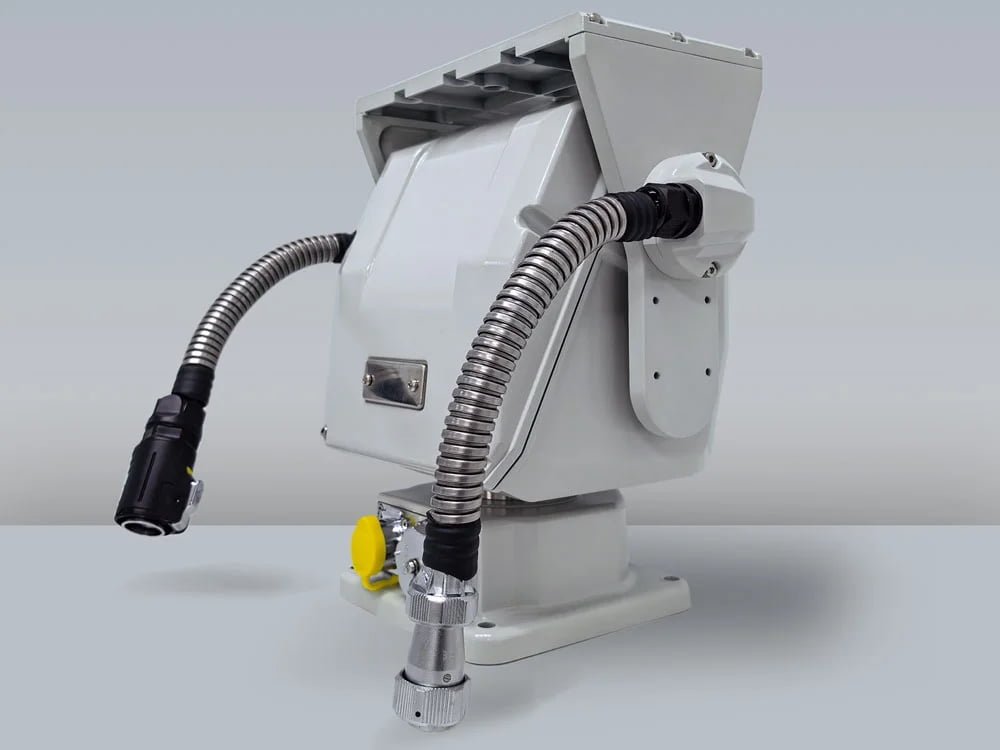
A motorized pan tilt positioner is a two-axis mechanical platform that rotates a mounted payload horizontally and vertically.
Compared with a complete PTZ camera, a separate pan tilt unit gives the integrator more choice. The integrator can choose the camera or sensor payload. The integrator can then integrate it independently.
A typical PTU can support:
- Visible cameras
- Thermal cameras
- EO/IR payloads
- Laser rangefinders
- Multi-sensor optical systems
- Industrial sensors
- Custom OEM payloads
This modular design is especially useful when the camera or sensor must be upgraded independently from the mechanical platform.
For projects that require a complete thermal camera and PTZ imaging system rather than a separate mechanical platform, see JEC’s Thermal PTZ Camera Product Range.
Start With the Payload, Not the Pan Tilt Unit
The first specification to determine is not pan speed. It is the payload.
Before selecting a motorized pan tilt head, document:
- Payload weight
- Payload dimensions
- Center of gravity
- Mounting position
- Cable routing
- Wind exposure
- Required acceleration
- Required positioning accuracy
A common mistake is to select a PTU based only on the nominal payload weight.
For example, a 10 kg sensor mounted close to the rotation axis may place a very different mechanical demand on a PTU than a 10 kg payload mounted on a long bracket with a high center of gravity.
For outdoor surveillance, the design should consider the entire mechanical load, including mounting brackets, cable harnesses, protective housings, and optional accessories.
A practical payload hierarchy
A useful starting point for procurement is:
| Payload Selection | Recommended PTU Range | Typical Application |
|---|---|---|
| Compact visible camera | 3–5 kg | Mobile / compact surveillance |
| Thermal camera | 5–15 kg | Perimeter / industrial security |
| EO/IR payload | 10–25 kg | Border / coastal / airport |
| Multi-sensor payload | 15–35 kg | Long-range / critical infrastructure |
The final model should still be selected using the complete mechanical configuration rather than weight alone.
JEC provides PTU configurations covering a broad payload range and supports project-specific payload integration.
Pan Tilt Positioner vs PTZ Camera: Which One Should You Buy?
A complete PTZ camera integrates the optics, sensors, electronics and motion system into one product.
A separate pan tilt unit is different. With a PTU, the system integrator can choose each component independently.
They can select a thermal camera or a visible zoom camera. They can also choose an EO/IR payload or a laser rangefinder. They may add a radar-linked optical payload or a custom multispectral sensor.
| Feature | Motorized PTU | Integrated PTZ Camera |
|---|---|---|
| Payload selection | Flexible | Fixed |
| Thermal integration | External payload | Built-in / model dependent |
| Visible camera selection | Flexible | Model dependent |
| OEM customization | High | Medium |
| Sensor upgrades | Easy | More limited |
| Multi-sensor integration | Strong | Model dependent |
| Mechanical integration | Customizable | Pre-configured |
This makes a pan tilt positioner particularly useful when the project requires custom sensor combinations, future payload upgrades, OEM/ODM integration, specialized mounting, custom communication protocols, or multi-vendor system integration.
JEC’s existing Heavy-Duty Pan-Tilt Head Selection for Multi-Sensor Payload Integration focuses on heavy payload engineering. It also focuses on multi-sensor integration. This guide looks at procurement in a broader way. It helps buyers choose the motorized pan tilt positioner architecture that best fits their needs.
Motorized Pan Tilt Positioner and PTZ Motion Demo.
See how a JEC pan-tilt platform moves with control.
It supports positioning and payload integration for professional surveillance systems.
Pan Speed Is Important, but It Is Not the Only Motion Specification
A common mistake is to compare PTU products only by their maximum pan speed.
High-speed movement matters for target tracking. It also supports counter-UAS systems.
It helps with border surveillance. It improves perimeter monitoring. It works well on mobile platforms. It enables fast alarm checks.
However, a good motorized pan tilt head must also move smoothly at low speeds. It must also settle accurately after a fast repositioning command.
| Specification | Why It Matters | Typical Project |
|---|---|---|
| Pan speed | Faster target acquisition | Counter-UAS / perimeter |
| Tilt speed | Rapid vertical repositioning | Tracking / mobile platforms |
| Position accuracy | Better target positioning | Long-range optics |
| Preset repeatability | Reliable return-to-target | Security monitoring |
| Settling time | Reduces image shake | Thermal / high zoom |
Other important motion characteristics include minimum controllable speed, acceleration, deceleration, backlash, and holding stability.
The operational sequence is more important than a single specification:
accelerate → move → decelerate → settle → observe
A PTU that moves fast but overshoots the target may work worse than a slower one.
A slower platform may perform better if it holds its position steady.
For high-speed surveillance applications, you should evaluate the PTU together with the actual optical payload.
360° Continuous Rotation or Limited Pan Range?
Another important decision is whether the application requires continuous pan rotation.
360° continuous pan is useful when:
- The camera is installed on a fixed tower
- Multiple sectors must be monitored
- A perimeter requires wide-area observation
- The camera operates as an alarm-verification platform
- A coastal or border installation needs broad azimuth coverage
Limited pan movement may be better when:
- The PTU is mounted on a vehicle
- The sensor is mounted on a ship
- The system has physical cable limitations
- The platform only needs to monitor a defined sector
- The application has a fixed directional field of view
The mechanical design should also consider cable routing.
It should consider slip-ring needs.
It should consider whether the payload needs continuous rotation for long periods.
Positioning Accuracy Matters More as Optical Zoom Increases
Positioning accuracy becomes increasingly important when a long focal-length camera is mounted on the PTU.
At a wide field of view, a small angular error may not be obvious. At a narrow field of view, the same angular error can move the target significantly across the image.
For high-zoom visible cameras and thermal imaging systems, consider:
- Angular resolution
- Position accuracy
- Preset repeatability
- Backlash
- Mechanical stiffness
- Settling time
- Vibration
A useful acceptance test should define payload installed, measurement distance, target size, approach direction, number of preset cycles, settling time, and temperature conditions. This makes supplier specifications easier to compare.

Match the PTU to the Camera or Sensor Type
The correct pan tilt positioner depends heavily on the payload.
Visible Camera
A visible camera may prioritize smooth zoom operation, high preset accuracy, fast target acquisition, and low vibration.
Thermal Camera
Thermal systems may require stable low-speed movement, accurate target positioning, mechanical stability at narrow fields of view, and compatibility with thermal payload dimensions.
EO/IR Payload
An EO/IR payload may combine thermal camera, visible zoom camera, laser rangefinder, GPS, and electronic compass. The PTU therefore has to handle a larger mechanical and electrical integration requirement.
For complete dual-sensor system selection, JEC’s Dual-Sensor Thermal PTZ Camera Selection Guide explains the full setup. It shows how thermal, visible, motion, and VMS functions must work together. They should not be evaluated independently.
Consider Payload Center of Gravity
Payload weight alone does not tell the complete story.
Two 15 kg payloads can act differently. This depends on width, height, mounting location, center of gravity, bracket length, and wind area.
For a tall optical payload, the center of gravity can create additional torque during acceleration and deceleration.
The RFQ should therefore include payload weight + dimensions + mounting drawing rather than weight alone. For OEM/ODM projects, this helps the manufacturer.
It lets them check the fit of the required motor.
It also lets them check the fit of the gearbox.
They can check the fit of the mounting structure.
They can also check the fit of the drive system.
Which Control Protocol Should You Choose?
A pan tilt positioner is part of the larger control system. Before ordering, confirm which protocol and interface your project requires.
Typical options include:
- RS485
- RS422
- Ethernet / IP
- Pelco-D
- Pelco-P
- ONVIF
- Custom protocol
Protocol compatibility should be checked with the camera controller, VMS, NVR, joystick, edge computer, radar or detection system, and command software.
A PTU that cannot communicate with the existing control architecture may require an additional converter or custom integration.
JEC also provides a dedicated ONVIF and VMS Integration Checklist for thermal PTZ camera projects. This is useful when the PTU or PTZ integrates with an existing video management platform.
Outdoor PTU Selection Goes Beyond IP Rating
For outdoor projects, check more than the enclosure rating. The complete system may need to tolerate rain, dust, humidity, temperature changes, wind, vibration, salt air, industrial pollutants, and solar heating.
Important specifications include:
- IP protection
- Operating temperature
- Material
- Surface treatment
- Cable protection
- Connector protection
- Surge protection
- Mounting rigidity
A PTU installed on a flexible pole can introduce visible vibration even when the PTU itself is mechanically stable.
For critical infrastructure and large-area projects, JEC’s Long Range Surveillance Camera Selection Guide offers extra guidance. It covers site geometry, mounting, and long-distance imaging needs.
How Much Control Integration Do You Need?
A simple PTU project may only require pan, tilt, preset, and speed control.
A more advanced system may require position feedback, preset patrol, alarm-triggered positioning, tracking commands, network control, sensor synchronization, and external target coordinates.
For an integrated EO/IR system, the PTU may need to work with thermal analytics. It may also work with visible camera tracking, radar, and detection sensors. It may also connect to VMS and command-and-control software.
The more complex the architecture, the more important it is to define the interface before issuing the purchase order.
Motorized Pan Tilt Head for OEM/ODM Projects
OEM buyers often require more than a standard catalog PTU. Typical requirements include custom mounting and payload brackets. They may also include special housings and connectors.
Other needs include firmware changes and protocol integration. Logo, branding, and mechanical changes are also common. Payload capacity may vary.
Therefore, you can use a standard product as the mechanical starting point while you customize the final configuration.
For projects with private-label products or integrated EO/IR systems, see JEC’s guide.
People call it How to Evaluate a Thermal PTZ Camera Manufacturer for OEM/ODM Projects.
How to Choose Between 5 kg, 10 kg, 15 kg and 35 kg PTU Platforms
Instead of choosing the highest capacity available, choose the smallest platform that comfortably meets the actual mechanical requirement.
| PTU Class | Payload | Best Fit |
|---|---|---|
| Compact PTU | 3–5 kg | Compact camera / thermal payload |
| Industrial PTU | 5–15 kg | Thermal / visible / EO/IR |
| Heavy PTU | 15–25 kg | Large EO/IR payload |
| Heavy-Duty PTU | 25–35 kg | Multi-sensor / long-range systems |
Final model selection should consider payload dimensions, center of gravity and mounting configuration — not payload class alone.
JEC’s Pan Tilt Unit Product Range can be used to compare different payload classes and mechanical configurations.

Heavy Duty Does Not Simply Mean “More Kilograms”
The term heavy duty pan tilt positioner can mean different things to different suppliers. For one manufacturer, it may mean 10 kg. For another, it may mean 35 kg. For a specialized defense or industrial platform, it may mean 100 kg or more.
Therefore, do not evaluate a PTU only by the marketing term heavy duty. Check payload, torque, center of gravity, mechanical stiffness, speed, position accuracy, environmental conditions, and duty cycle.
The goal is not to buy the strongest PTU — it is to buy a PTU that provides the required performance without unnecessary size, weight and power consumption.
Motorized Pan Tilt Positioner Selection Checklist
Before sending an RFQ, confirm these ten points:
- Payload weight
- Payload dimensions
- Center of gravity
- Required pan range
- Required tilt range
- Required pan and tilt speed
- Positioning accuracy
- Outdoor/environmental conditions
- Control protocol
- Mounting and cable requirements
For an EO/IR project, add:
- Thermal lens and detector requirements
- Visible zoom requirement
- LRF/GPS/e-compass requirements
- VMS or command-system interface
- Target distance and operating scenario
Common PTU Selection Mistakes
Mistake 1: Selecting by payload weight only
A 15 kg payload does not automatically require the same PTU as every other 15 kg payload.
Mistake 2: Choosing the fastest PTU
Maximum speed does not guarantee accurate target positioning.
Mistake 3: Ignoring center of gravity
A poorly balanced payload can affect motor load and positioning stability.
Mistake 4: Treating the PTU and payload as separate products
The mechanical and optical systems must be evaluated together.
Mistake 5: Checking only IP rating
Outdoor reliability also depends on temperature, vibration, wind, corrosion and mounting.
Mistake 6: Leaving protocol requirements until the end
RS485, Pelco-D/P, ONVIF and IP integration should be confirmed before ordering.
Mistake 7: Choosing the highest payload class “just in case”
A larger PTU can increase size, weight and cost unnecessarily.
A Practical RFQ Example
Instead of sending:
“Please quote a pan tilt unit.”
A better RFQ provides the following:
| RFQ Information | Example |
|---|---|
| Payload | 12 kg EO/IR |
| Dimensions | 320 × 220 × 180 mm |
| Pan | 360° continuous |
| Tilt | ±90° |
| Speed | Project specific |
| Control | RS485 + IP |
| Protocol | Pelco-D / custom |
| Environment | Outdoor |
| Quantity | 1 unit prototype |
| Required Documents | Datasheet + mechanical drawing |
Providing these details allows the manufacturer to recommend the correct PTU instead of sending a generic product specification.
Related JEC Resources
For a complete project evaluation, these resources can be reviewed together:
- Pan Tilt Unit Product Range
- Heavy-Duty Pan-Tilt Head Selection
- Dual-Sensor Thermal PTZ Selection Guide
- ONVIF and VMS Integration Checklist
- Long Range Surveillance Camera Selection Guide
- Thermal PTZ Manufacturer OEM/ODM Guide
- Thermal PTZ Camera Systems
- Contact JEC for Project Requirements
These articles should be treated as a related content cluster: the current guide focuses on PTU procurement and selection, while the other resources address heavy payload integration, thermal/visible imaging, VMS integration, long-range surveillance and OEM/ODM sourcing.
FAQ
What is a motorized pan tilt positioner?
A motorized pan tilt positioner is a two-axis platform that rotates a camera or sensor payload horizontally and vertically under motorized control.
What is the difference between a pan tilt unit and a PTZ camera?
A pan tilt unit is primarily a mechanical positioning platform, while a PTZ camera integrates the positioning mechanism with imaging sensors, optics and electronics.
What payload should I choose for a pan tilt unit?
Start with payload weight and dimensions, then evaluate center of gravity, mounting position and environmental load. Payload capacity alone is not enough.
Can a pan tilt unit support a thermal camera?
Yes. A PTU can be integrated with thermal, visible, EO/IR and multi-sensor payloads when the mechanical and electrical interfaces are correctly specified.
Do pan tilt positioners support RS485 and Pelco?
Many surveillance-oriented PTUs support RS485-based control and Pelco protocols. The required protocol should be confirmed before ordering.
Can I buy one PTU for testing?
Yes. JEC supports small-quantity project requirements and OEM/ODM development.
Can JEC provide mechanical drawings?
Yes. Mechanical drawings and datasheets can be provided for project evaluation and integration.
Can JEC customize the PTU for a specific payload?
Yes. JEC supports payload integration and project-based OEM/ODM customization.
Conclusion: Choose the PTU Around the Mission
The best motorized pan tilt positioner is not necessarily the largest, fastest or most expensive model.
The correct selection starts with the mission:
- What payload will be installed?
- How far away is the target?
- How quickly must the system move?
- How accurately must it return to a target?
- What protocol does the control system require?
- What environmental conditions will the PTU experience?
- Does the payload need thermal, visible, EO/IR or multispectral integration?
- Will the system be installed on a tower, vehicle, vessel or industrial platform?
- Does the project require OEM/ODM customization?
Once these requirements are defined, the PTU can be selected around the actual payload and operating workflow rather than around a generic product specification.
For a project-specific recommendation, send JEC:
Payload weight + dimensions + center of gravity + required pan/tilt range + speed + protocol + mounting environment + quantity
JEC can then recommend a suitable pan tilt unit, motorized pan tilt head or positioner configuration, provide datasheets and mechanical drawings, and discuss OEM/ODM integration options.