Compare NETD figures only when the measurement basis is disclosed and comparable. Ask for the test method, source temperature, optics, camera settings, processing state, and whether the result describes a detector, module, or complete camera. Then assess the camera against the target task and field of view. A lower NETD can indicate better sensitivity under matching conditions; it does not, on its own, establish detection distance, identification performance, or temperature accuracy.
What NETD Measures
NETD, also written NEDT or NEdT, is a noise-related measure of thermal sensitivity. It expresses the temperature difference corresponding to a camera’s temporal noise under stated test conditions. Suppliers commonly report it in millikelvins. Lower values can indicate sensitivity to smaller differences when the test basis matches.
NETD is not a complete image-quality score. It does not tell you whether the image is in focus, whether a target fills enough pixels, or whether the camera can distinguish a target from a particular background at a stated distance. It is also different from radiometric temperature accuracy, calibration error, drift, and long-term stability. Optris explains the distinction between NETD and other measurement properties; use the term that appears in each supplier’s report and ask what it means there.
Define the Task Before Comparing the Numbers
Define whether the system must detect, recognize, identify, or measure temperature. Record the target, movement, observation geometry, field of view, focus, and representative background. State whether thermal video only cues a visible camera.
NETD cannot be converted directly into surveillance range. Detector format, lens and field of view, focus, processing, target contrast, atmosphere, and motion all affect the result. Compare systems against the same task and optical coverage. The thermal PTZ and long-range EO/IR system context can help frame the complete imaging chain without making NETD stand in for it.
Check the Measurement Conditions
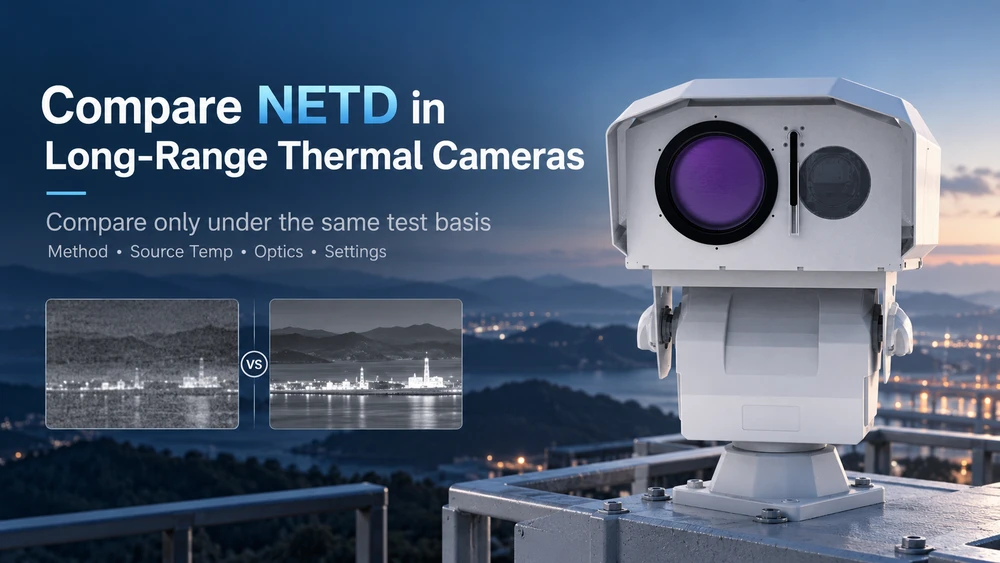
Two datasheets may show different NETD values because the tests used different conditions. Request the test report or a signed configuration sheet and check these fields:
- Source: source type, radiance or temperature, stability, and ambient conditions during measurement.
- Optics: exact lens, aperture or F-number, filter, and whether the number is measured through that optic or normalized to another basis.
- Measurement point: detector, camera module, or complete camera with lens and processing chain.
- Camera settings: integration time, frame rate, gain, operating mode, and detector temperature or stabilization state where applicable.
- Corrections and processing: non-uniformity correction, filtering, temporal averaging, sharpening, or other image processing enabled or bypassed.
- Calculation: measurement method, sampled area, frame count or duration, statistic used, and how the reported value was derived.
The purpose is to expose each supplier’s method, not to assume all labs use one procedure. Axis, for example, describes a method using a blackbody, specified optics, correction and processing states, and collected frames. It is a manufacturer example, not a universal acceptance standard.
Relate NETD to the Operational Image
Then check the complete configuration: lens coverage, focus, detector resolution, processing, PTZ motion, and operator task. Review imagery using representative targets, backgrounds, and operating conditions.
When assessing quotations, keep detector-specific evidence separate from the full camera and system scope. The guide to comparing complete thermal PTZ quotations covers wider configuration and commercial questions.
Video: JEC PTZ Focus and Stability Check
This video shows focus and PTZ stability checks. It is not a NETD measurement or validation of a NETD specification.
Plan NETD Evidence for FAT and SAT
Before testing, freeze the camera, lens, firmware, operating mode, processing, and method. Record source and ambient conditions, setup, correction state, and report version. Note whether later changes affect applicability.
Keep a controlled NETD measurement distinct from an operational scene demonstration. The first checks the reported noise-related sensitivity under a defined setup. The second checks whether the installed system supports the agreed surveillance task. They answer different questions.
- Agree who supplies the source, test equipment, and configuration records.
- Define how samples or units are selected and how results are recorded.
- Set acceptance limits and retest rules before FAT or SAT; obtain engineering approval for all numeric criteria.
- Record deviations, environmental conditions, image output, and responsible reviewer.
A lab figure does not prove field detection or identification distance. Link each acceptance requirement to its configuration and verification evidence.
NETD RFQ Checklist
Ask each supplier to provide:
- Exact detector, module or camera configuration and test report date.
- NETD value, units, measurement point, method, and calculation basis.
- Source temperature and ambient conditions.
- Lens, F-number, filters, settings, correction and processing state.
- Sample basis, limitations, and confirmation that the proposed operating mode matches the reported result.
- Separate evidence for the required target task and field of view.
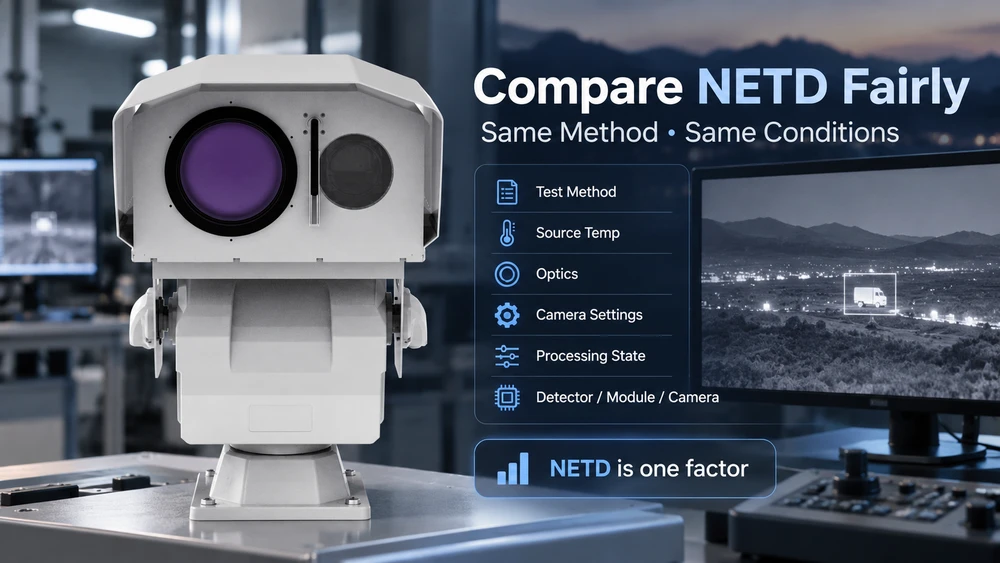
Red flags include an isolated mK figure, undisclosed optics, no source conditions, or a claim that NETD alone proves range. For a relevant JEC multi-sensor thermal PTZ configuration, ask the product team which test evidence applies to the exact quoted model. This link does not validate a published NETD figure or imply that the page’s value has been independently checked.
Frequently Asked Questions
What does NETD mean on a thermal camera datasheet?
It is a noise-related measure of thermal sensitivity under stated test conditions. Ask the supplier how the value was measured and what configuration it describes.
Is a lower NETD always better?
It may indicate sensitivity to smaller thermal differences when the measurement basis is comparable. It does not establish that the camera is better for every task.
Does NETD determine thermal camera detection range?
No. Range depends on the complete imaging system, target task, optics, focus, scene, and conditions. Require task-specific evidence.
Is NETD the same as temperature measurement accuracy?
No. NETD concerns noise-related sensitivity. Radiometric accuracy, calibration, and stability require separate specifications and evidence.
What should a supplier NETD report include?
Request the exact configuration, source and temperature, optics, camera settings, correction and processing state, method, calculation basis, and report date.
Conclusion
A NETD comparison is useful only when the test basis is clear. Match the source conditions, optics, settings, processing, and measurement point, then judge the complete camera against the required surveillance task. Send suppliers the same RFQ checklist and keep missing evidence visible until clarified.
For a project review, share the compared datasheets or test reports, target task, observation conditions, and required lens or field of view with JEC. Review the JEC thermal PTZ camera range as a product enquiry starting point, then ask which specification details apply to the configuration being quoted.