A modern drone detection project is not just about finding a flying object. For airports, industrial perimeters, oil and gas facilities, ports, military bases, and critical infrastructure, the real challenge is to detect the drone early, track its movement, confirm whether it is a real threat, and give operators clear visual evidence.
That is why a practical anti-drone system usually combines radar or RF detection, thermal PTZ camera technology, long-range visible optics, AI-assisted target tracking, and a command platform. In this workflow, the anti-drone PTZ camera radar thermal combination becomes the bridge between early warning and operational decision-making.
Industry solutions are moving in the same direction. Radar and RF sensors are commonly used for early drone detection, while integrated PTZ cameras with thermal and optical zoom help confirm and track the target in real time. JEC’s anti-drone solution is built around long-range PTZ tracking, EO/IR visual confirmation, intelligent target handoff, and centralized command visualization for airports, ports, borders, oil and gas, and other high-value sites.
Why Airport Drone Detection Needs More Than One Sensor
Drones are difficult targets. They are small, fast, low-altitude, and often appear against complex backgrounds such as airport buildings, perimeter fencing, hills, clouds, birds, cranes, or city lights.
A single visible camera may miss drones at night. A radar may detect movement but cannot provide visual evidence by itself. RF detection may identify possible control signals, but it may not always provide enough image confirmation for a security response.
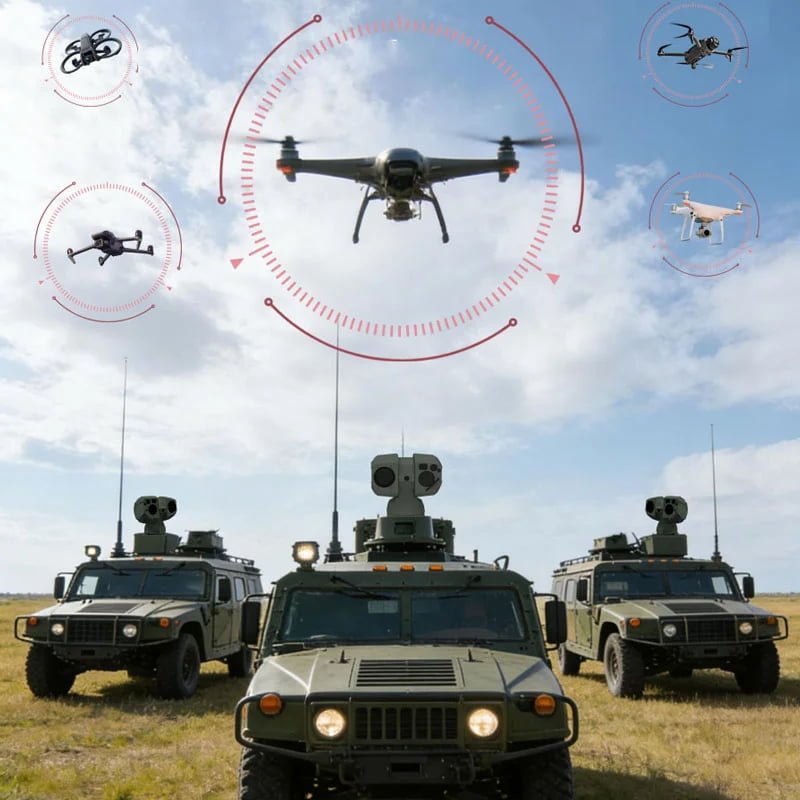
A reliable airport drone detection system should therefore use multiple sensors:
- Radar for wide-area airspace detection
- RF or other detection sources for signal-based alerts
- Thermal imaging for night and low-visibility confirmation
- Long-range visible zoom for visual identification
- PTZ positioning for continuous tracking
- VMS or command software for alarm handling and evidence recording
This is the core value of a radar thermal PTZ design: every sensor does what it is best at, and the PTZ camera turns detection data into usable video intelligence.
Detection Logic: Radar First, PTZ for Visual Confirmation
In many airport and perimeter projects, radar acts as the first detection layer. It scans a wide area and identifies moving aerial targets. RF detection can be added to detect drone communication signals. Perimeter systems may also trigger alerts when a drone approaches a restricted zone.
Once a suspicious object is detected, the system should not rely on the operator to manually search the sky. Instead, the detection source should send target data to the PTZ camera or command platform.
A typical detection logic looks like this:
- Radar or RF detects a possible UAV.
- The command platform receives target position, direction, and movement data.
- The PTZ camera automatically turns toward the target area.
- Thermal imaging confirms whether the object has a heat signature.
- Visible optical zoom helps identify the target shape and movement.
- The operator reviews live video, alarm data, and recorded evidence.
This workflow helps reduce manual search time and gives security teams faster situational awareness.
Slew-to-Cue Workflow: From Radar Alert to Thermal PTZ Tracking
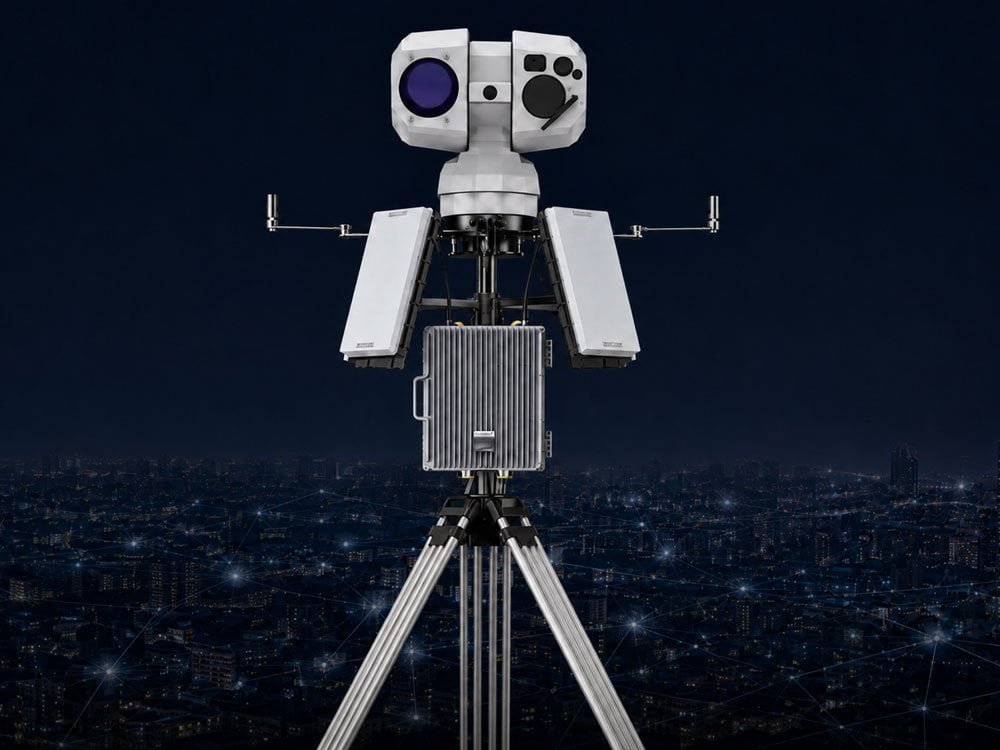
The most important concept in a C-UAS camera system is “slew-to-cue.” This means the radar, RF detector, or command platform “cues” the PTZ camera, and the PTZ automatically slews to the target direction.
This is already a recognized direction in the market. Axis describes radar autotracking as using radar motion data to automatically control the direction and zoom level of one or multiple PTZ cameras for visual confirmation, reducing the need for manual joystick control.
For airport and perimeter drone detection, this workflow is especially valuable because small UAVs may only appear briefly in a camera’s field of view. A PTZ camera that waits for manual control may lose the target. A PTZ camera connected to radar or RF alerts can respond faster.
For JEC PTZ projects, the workflow can be described as:
Radar detection → target handoff → EO/IR PTZ positioning → thermal verification → visible zoom identification → AI-assisted tracking → command center response
This turns the PTZ camera into an active tracking node, not just a passive video device.
Classification and Verification: Drone, Bird, or False Alarm?
Detection is only the first step. In real projects, operators also need to know whether the object is a drone, a bird, a balloon, an aircraft, or environmental noise.
This is where a drone tracking camera with thermal and visible channels becomes important.
Thermal imaging helps detect and observe targets in darkness or low-light conditions. Visible zoom helps operators identify structure, movement pattern, and flight behavior. Some systems also use AI analytics to support object classification, target tracking, and alarm filtering.
For better false alarm control, integrators should consider:
- Target size filtering
- Speed and altitude rules
- Restricted zone configuration
- Thermal and visible image cross-checking
- Radar track continuity
- AI object classification
- Operator confirmation before escalation
- Event recording for post-incident review
The purpose is not to let the system automatically treat every moving object as a threat. The purpose is to give operators enough data to make a confident decision.
What to Look for in a Radar Thermal PTZ System
For anti-drone integrators and airport contractors, camera selection should not be based only on zoom ratio or appearance. A project-ready radar thermal PTZ camera should support the full detection-to-verification workflow.
Important selection factors include:
1. Long-Range Visible Zoom
The visible camera should provide enough optical zoom to help operators identify a small aerial target at long distance. JEC’s Long Range Anti-Drone PTZ Surveillance System uses a 55x optical zoom visible module and is designed for UAV detection, tracking, and visual confirmation in airports, military bases, oil and gas facilities, borders, and smart city airspace protection.
2. Thermal Imaging for Night and Low Visibility
A drone threat may appear at night, near perimeter lighting, or in poor visibility. Thermal imaging helps operators confirm heat signatures when visible cameras struggle.
3. Fast and Stable PTZ Movement
Drone targets move quickly. The PTZ mechanism must respond fast, position accurately, and remain stable under wind, vibration, or tower movement. JEC’s anti-drone PTZ platform highlights high-response mechanical stabilization, precise positioning, and target lock support under challenging conditions.
4. Multi-Sensor Expansion
For higher-value projects, integrators may require visible imaging, thermal imaging, laser rangefinding, GPS-related capability, AI analytics, and radar integration. JEC’s Multi-Sensor Thermal PTZ Camera supports visible imaging, thermal imaging, laser ranging, GPS-related capability, ONVIF Profile S/G, RS485/422, PELCO-D, alarm I/O, and mainstream platform integration.
5. VMS and Command Platform Compatibility
The system should be easy to connect with the customer’s VMS, PSIM, radar software, or C2 platform. ONVIF Profile S is relevant because it supports IP video streaming and PTZ control for conformant devices and clients.
Recommended System Architecture
A practical airport or perimeter C-UAS camera system can be divided into three layers.
Perception Layer
This layer includes radar, RF detection, EO/IR PTZ cameras, thermal PTZ cameras, fixed cameras, and local perimeter sensors.
Recommended JEC-related product links:
- Anti-Drone System
- Long Range Anti-Drone PTZ Surveillance System
- Thermal PTZ Camera
- Multi-Sensor Thermal PTZ Camera
Transmission Layer
This layer carries video, metadata, radar events, alarm signals, and control commands. Airport and critical infrastructure projects should consider fiber, secure IP networks, redundant transmission, and cybersecurity design.
Command and Verification Layer
This layer brings alerts, live video, target location, tracking status, and event history into one operator interface. It should support alarm prioritization, visual confirmation, recording, operator override, and response coordination.
Application Scenarios
A radar + thermal + PTZ anti-drone system is especially suitable for:
- Airport runway and terminal perimeter protection
- Oil and gas facility airspace monitoring
- Military base low-altitude security
- Port and coastal drone intrusion detection
- Border and desert perimeter surveillance
- Power plant and utility infrastructure protection
- Prison and high-security facility monitoring
- Temporary event or emergency response deployment
For these projects, the PTZ camera should not be specified as a standalone camera. It should be specified as part of a multi-sensor workflow.
Buyer Checklist for Anti-Drone Integrators
Before requesting a solution, prepare the following information:
- Site type: airport, refinery, border, port, base, or industrial perimeter
- Detection source: radar, RF, acoustic sensor, VMS alarm, or third-party C-UAS platform
- Required detection and verification distance
- Day/night operation requirements
- Expected drone size and flight altitude
- PTZ mounting height and installation position
- Required optical zoom and thermal lens
- VMS, PSIM, or command platform brand
- Required protocols: ONVIF, RTSP, SDK/API, RS485/422, PELCO-D
- Recording, alarm, and evidence retention workflow
- Environmental conditions: desert, coastal, high humidity, strong wind, or cold climate
This information helps JEC PTZ recommend a more accurate anti-drone PTZ camera radar thermal configuration.
A radar thermal PTZ system for drone detection uses radar or RF sensors to detect UAV activity, then automatically cues an EO/IR PTZ camera toward the target. The thermal channel supports night and low-visibility verification, while the visible zoom camera helps operators identify the drone and record visual evidence. This architecture is suitable for airport drone detection, perimeter C-UAS projects, critical infrastructure, oil and gas sites, ports, borders, and military bases.
Key Takeaways
- Radar provides wide-area early warning.
- Thermal PTZ cameras help confirm drones at night or in poor visibility.
- Visible optical zoom supports target identification.
- Slew-to-cue workflow reduces manual joystick control.
- AI classification and operator verification help reduce false alarms.
- ONVIF, RTSP, SDK/API, and command platform compatibility are important for integrators.
- JEC PTZ provides long-range EO/IR PTZ and anti-drone PTZ platforms for B2B security projects.
FAQ
Q1: What is an anti-drone PTZ camera radar thermal system?
It is a multi-sensor drone detection architecture that combines radar or RF detection with thermal PTZ and visible zoom cameras. Radar detects the target, while the PTZ camera provides visual confirmation and tracking.
Q2: Why is thermal imaging important for drone detection?
Thermal imaging helps operators detect and verify aerial targets in darkness, low light, haze, or poor visibility where visible cameras may struggle.
Q3: What does slew-to-cue mean in a drone detection system?
Slew-to-cue means a radar, RF detector, or command platform sends target position data to the PTZ camera, allowing the PTZ to automatically turn toward the target.
Q4: Can a radar thermal PTZ system connect to a VMS?
Yes. A project-ready system should support common video and control interfaces such as ONVIF, RTSP, SDK/API, RS485/422, PELCO-D, alarm I/O, and command platform integration.
Q5: Is this system suitable for airports?
Yes. It is suitable for airport perimeter protection, runway approach monitoring, terminal-area airspace awareness, and low-altitude drone verification when integrated with the airport’s security workflow.